The Stories We Carry Long After the Sirens Fade
Category: Personal Reflections
There are some stories that never really leave us.
In law enforcement, a call has an ending.
The scene clears. The radio moves on to the next call. Reports are written. Evidence is logged. Eventually, the shift ends and you go home.
But not everything stays at work.
For nearly two decades, I wore a badge, and some of the moments I remember most aren’t the dramatic ones people might expect.
Sometimes it’s a face.
A few words someone said.
A family standing together on the worst day of their lives.
A moment of unexpected humor in the middle of complete chaos.
Or a person showing extraordinary courage without ever realizing anyone noticed.
Those are the things that stayed with me.
Police reports record facts. They document what happened, where it happened, who was involved, and what was done.
They don’t always capture what a moment felt like.
They don’t record the silence after terrible news is delivered. They don’t describe the look exchanged between two people who don’t need words. They don’t tell you about the laughter officers sometimes use to get through something difficult—or what it feels like to drive away from one call knowing another is already waiting.
And they certainly don’t tell you which calls will still cross your mind years later.
That’s the part of life behind the badge I’ve become interested in writing about.
Not simply what happened, but what remained after it happened.
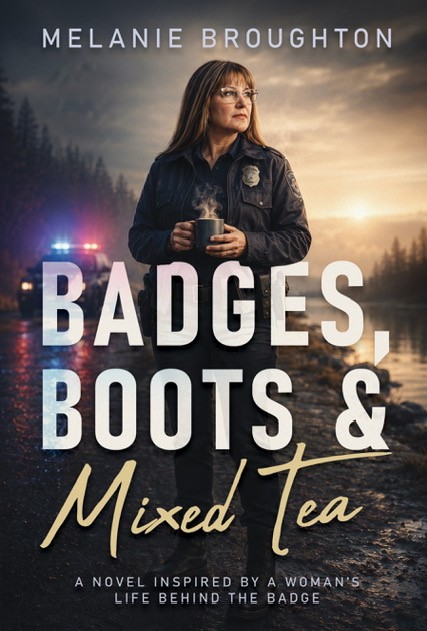
When I began writing Badges, Boots & Mixed Tea, I knew I didn’t want to write a police procedural. I wasn’t interested in building a story around reports, statutes, arrests, and investigations.
I wanted to explore what happens to the person wearing the uniform, the person behind the headset.
What do they carry home?
What makes them laugh when they desperately needs to?
Which calls change them?
Which ones haunt them?
And after years of being the person others depend on during a crisis, what happens when she becomes the one who needs help?
That’s where Riley Bullock and dispatcher Pheobe began to take shape.
Riley is fictional, but the idea that some calls don’t end when the radio goes quiet is something I understand.
It’s also why the people in these stories matter so much to me.
During my years in law enforcement, I met people for only minutes whose strength stayed with me for years. Most will never know that. They were simply living through something difficult while I happened to be standing there.
But they taught me something.
We rarely know which moments will become part of someone else’s story.
Maybe that’s why I write now.
Not to retell anyone else’s story.
Not to recreate police reports.
But to write about the things a report could never capture.
The humanity.
The complicated emotions.
The laughter that sometimes appears where it shouldn’t.
The heartbreak that follows you home.
The unanswered questions.
And the quiet decision to get up and do it all again tomorrow.
The sirens eventually fade.
Some stories don’t.
Those are the stories I carry. And somewhere between the badge and the page, I finally found a place to put them.